

- Summary
- What Is Electronic Data Capture (EDC) in Clinical Trials?
- EDC vs eCRF Tools: The Difference
- How Does an EDC System Work in a Clinical Trial?
- How Data Enters an EDC System
- Types of Data Captured by an Electronic Data Capture System for Clinical Trials
- Core Data Management Capabilities of an EDC System
- Integrating EDC System with Other Platforms
- Key Features to Look for in a Modern EDC System
- Key Benefits of EDC Systems in Clinical Trials
- Emerging Trends in EDC Technology
- Future Directions for Electronic Data Capture Systems
- Conclusion
- External References
Summary
An Electronic Data Capture (EDC) system is software used to collect, manage, validate, and store clinical trial data electronically, primarily through electronic case report forms (eCRFs). EDC systems give sites, sponsors, CROs, monitors, and data managers controlled access to study data while supporting edit checks, query management, audit trails, reporting, and data review. Modern EDC platforms can also exchange data with systems such as EHRs, laboratories, eCOA/ePRO platforms, and other clinical trial technologies.
What Is Electronic Data Capture (EDC) in Clinical Trials?
EDC systems are software solutions that facilitate the collection, management, and storage of clinical trial data.
Unlike manual paper methods, EDC platforms provide features such as real-time data access, automated checks for data quality, and comprehensive audit trails. These capabilities ensure that data is reliable and readily available for decision-making throughout the clinical trial process.
EDC vs eCRF Tools: The Difference
While closely related, electronic data capture (EDC) systems and electronic case report forms (eCRFs) are not the same.
An eCRF is a structured electronic form within the EDC used to capture protocol-required study data. The EDC is the broader software environment that manages those forms along with validation rules, queries, audit trails, user access, review workflows, and data exports.
For instance, an eCRF captures individual patient data, whereas the EDC system ensures that data is validated, consolidated, and readily available for analysis and reporting.
How Does an EDC System Work in a Clinical Trial?
An EDC system supports the clinical data workflow from study setup through database finalization. The process typically begins with configuring eCRFs, visit schedules, edit checks, user roles, and data review workflows based on the study protocol.
Once the study is live, site users enter subject data directly into the EDC, while data from approved external sources may also be transferred or integrated into the system. As data is collected, configured validation checks help identify missing, inconsistent, or out-of-range values.
When clarification is required, queries can be raised against specific data points and addressed by the appropriate site or study users. Data managers, monitors, and other authorized team members then review the data, query history, and audit trail as part of the data-cleaning process.
After required reviews and data-cleaning activities are completed, the database can be finalized and locked, allowing the study data to move forward for statistical analysis and reporting.
How Data Enters an EDC System
EDC systems provide various methods for collecting data, making them adaptable to different trial designs and needs:
Direct Data Entry
Clinical site staff input patient data directly into the EDC platform, reducing transcription errors and ensuring that data is immediately available for review by sponsors and CROs.
Transcription from Source Records
Data initially collected on paper or in other electronic formats can be transcribed into the EDC system. This method ensures that all trial data resides in a single, unified platform, ready for analysis.
Electronic Data Transfer and Integration
Wearables, lab equipment, and EHRs can feed data automatically into the EDC, enabling real-time monitoring, reducing manual effort, and ensuring high data accuracy.
Types of Data Captured by an Electronic Data Capture System for Clinical Trials
EDC systems handle a wide range of data types vital to the success of clinical research.
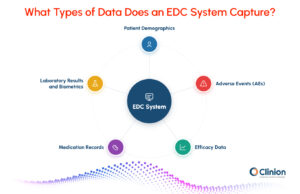
Below are the key categories:
Patient Demographics
- Age and Gender: Identifies treatment trends across population groups and ensures compliance with inclusion/exclusion criteria.
- Medical History: Includes conditions, family health history, and previous treatments that can influence outcomes.
- Ethnicity and Location: Ensures diversity in the trial population and provides insights into the generalizability of results
Adverse Events (AEs)
- Safety Data Capture: Adverse events and serious adverse events can be recorded within study-specific eCRFs and made available for review according to the study workflow. Where configured, integrations can also support the exchange or reconciliation of relevant safety data with pharmacovigilance systems.
- Severity Classification: Differentiating between serious and non-serious events ensures appropriate resource allocation.
- Resolution Tracking: Monitoring event management and resolution helps ensure participant safety and regulatory compliance.
Efficacy Data
- Standardizing Outcome Measures: Uniform data collection enables comparability across sites and populations.
- Ongoing Data Review: Enables authorized study teams to review accumulating study data, identify missing or inconsistent information, and monitor data completeness during study conduct.
Medication Records
- Dosage Tracking: Captures detailed administration data, including timing and quantity.
- Compliance Monitoring: Identifies deviations from prescribed regimens and ensures adherence.
- Interaction Analysis: Links medication data with adverse events to investigate potential correlations.
Laboratory Results and Biometrics
- Automated Data Transfer: Reduces errors and delays, allowing for timely analysis.
- Device Integration: Captures real-time biometric data from wearables, enriching the trial dataset.
Core Data Management Capabilities of an EDC System
EDC systems streamline data management in clinical trials by offering advanced tools that address data complexities:
Automated Validation Rules
Built-in checks instantly flag data entry errors or inconsistencies, such as out-of-range values or missing data. For instance, if a patient’s recorded weight exceeds predefined limits, the system immediately prompts a query, ensuring real-time resolution.
Real-Time Dashboards
Dashboards provide trial sponsors with real-time metrics such as data completion rates, site performance, and emerging trends. These dashboards allow proactive decision-making, ensuring that trials remain on schedule and any bottlenecks are addressed promptly.
Comprehensive Audit Trails
Detailed logs of every action, from data entry to modifications, ensure transparency and compliance. These trails are indispensable during regulatory audits, as they demonstrate the integrity of the data.
Query Management
When data is missing, inconsistent, or requires clarification, authorized users can raise queries against specific data points. Site users can respond or correct the relevant data, while the EDC maintains the query history as part of the study's data management workflow.
Integrating EDC System with Other Platforms
Integration with other platforms enhances trial coordination:
- Clinical Trial Management Systems (CTMS): Real-time synchronization of clinical and operational data enables centralized oversight and streamlined reporting.
- Lab Information Management Systems (LIMS): Automated transfer of lab results eliminates manual entry, reducing errors and delays.
- Wearables and IoT Devices: Real-time monitoring enhances the depth of collected data, especially in decentralized and hybrid trial models.
- Pharmacovigilance Systems: Integration with safety reporting platforms ensures compliance with regulatory timelines for adverse event submission.
ePRO and EDC Integration: A Practical Guide for Clinical Trials
Learn how ePRO and EDC integration helps clinical teams connect patient-reported outcomes with clinical trial data, reduce manual reconciliation, improve data quality, and support faster review workflows.
Key Features to Look for in a Modern EDC System
Modern EDC systems include:
- Global Libraries: Predefined templates and standards for quicker study setups.
- AI-Powered Data Review: Automates dataset generation, enabling data managers to perform reviews and raise queries with minimal manual intervention.
- Customizable eCRFs: Tailored to capture data specific to each trial’s protocol, ensuring all required data points are collected efficiently.
- Real-Time Monitoring Dashboards: Provides sponsors and CROs with up-to-date insights into trial progress.
- Integration Capabilities via APIs: Facilitates seamless interoperability with CTMS, LIMS, and EHRs.
- AI-Driven Report Generation: On-demand reports with minimal manual effort.Related Blog
Top EDC Software Solutions for Clinical Trials
Compare leading EDC platforms by data capture, eCRF design, compliance, integrations, query management, usability, and clinical trial workflow fit.
Related BlogAI EDC Platforms Compared for Clinical Trials
Compare how leading EDC platforms use AI across study setup, data review, coding, source-data extraction, reporting, query management, and human oversight.
Key Benefits of EDC Systems in Clinical Trials
EDC systems offer several benefits that improve clinical data management and support more efficient trial execution.
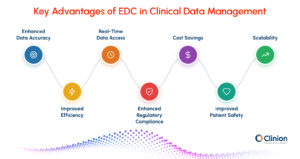
Enhanced Data Accuracy
EDC systems significantly reduce errors through automated validation checks and real-time data entry. This helps identify missing, invalid, or inconsistent data earlier and can reduce downstream data-cleaning effort.
Improved Efficiency
By digitizing data collection and management, EDC systems streamline workflows, reduce redundancies, and save time. This allows research teams to focus on core trial activities, such as patient care and analysis.
Real-Time Data Access
Sponsors, CROs, and site staff can access trial data instantly through centralized dashboards. This enables faster decision-making and more effective trial oversight.
Enhanced Regulatory Compliance
Appropriately configured and validated EDC systems can support requirements for controlled access, electronic records, audit trails, electronic signatures, traceability, and data integrity.
Cost Savings
Automating data management reduces the time and resources needed for manual data entry, monitoring, and validation. This translates to significant cost savings over the course of a clinical trial.
Improved Patient Safety
Timely access to safety-related study data can help authorized study teams review adverse events, missing information, and other safety-relevant data as part of established trial oversight processes.
Scalability
EDC systems are scalable, making them suitable for trials of varying sizes and complexities. From small single-site studies to large global trials, EDC systems for clinical research can adapt to the needs of any project.
These benefits of the EDC system make it an indispensable tool for modern clinical research, enhancing efficiency, accuracy, and compliance.
Key Benefits of Electronic Data Capture Systems in Clinical Trials
Learn how electronic data capture systems improve clinical trial data quality, reduce manual entry, support real-time validation, simplify query management, strengthen compliance, and accelerate database readiness.
Emerging Trends in EDC Technology
- AI & ML: Automates validation, detects anomalies, and predicts potential issues, reducing manual intervention.
- Enhanced User Experience (UX): Simplified workflows, intuitive interfaces, and mobile-first designs to improve adoption.
- Support for Decentralized Trials: Adapts to remote monitoring, virtual site visits, and telemedicine platforms, making trials more accessible.
- Cloud-Based Solutions: Enhance scalability, collaboration, and cost efficiency for global trials.
EDC System Migration: A Practical Guide for Clinical Teams
Learn how clinical teams can plan, validate, and execute EDC system migration while protecting data integrity, maintaining study continuity, reducing migration risk, and supporting inspection-ready documentation.
Future Directions for Electronic Data Capture Systems
- Predictive Analytics: Leveraging historical trial data and ML models to forecast outcomes and optimize designs.
- Greater Interoperability: Seamlessly integrating with digital health technologies such as EHRs, wearables, and lab systems to create unified ecosystems.
- Enhanced User Experience (UX): Simplified workflows, intuitive interfaces, and mobile-first designs to improve adoption.
- Regulatory-Ready Solutions: Incorporating advanced features for data anonymization and compliance with standards like GDPR and 21 CFR Part 11.
- Expanded NLP Capabilities: Enabling deeper analysis of unstructured data fields, such as free-text entries in eCRFs.
How to Choose EDC Software for Clinical Trials
Compare EDC features, compliance, integrations, validation, implementation, and vendor readiness before selecting a platform.
Read the EDC Buyer Guide →
Conclusion
Electronic Data Capture systems are indispensable for modern clinical trials. By streamlining data collection, ensuring regulatory compliance, and enhancing trial quality, EDC systems empower researchers to accelerate therapeutic development efficiently.
As clinical trials draw data from more sources, EDC systems are evolving toward greater interoperability, more automated data review, and closer integration with the broader eClinical ecosystem.
AI-enabled EDC software for smarter clinical data capture
See how Clinion EDC helps clinical teams capture, review, validate, and manage trial data with AI-enabled workflows, real-time edit checks, query management, audit trails, and inspection-ready data control.
External References